Introduction
If you've played any city builder before, you'll know that they take a generous amount of creative liberty with how cities function. This is often necessary to keep the game approachable and fun for a casual audience, but simplifies the experience to such an extent that it becomes impossible to capture the true depth of managing a city.
Here's a few of the more common issues I've seen:
- Buildings have artificially high occupancy numbers to mask how small the simulation is
- Residents won't use services when they're five minutes away
- Infrastructure is so cheap its practically free
- Cars don't require parking and simply disappear when they reach their destination
- You're able to demolish entire neighborhoods at no cost and with no repercussions
I don't think anyone will be surprised to learn this is not how cities work in the real world.
What is Metrotown?
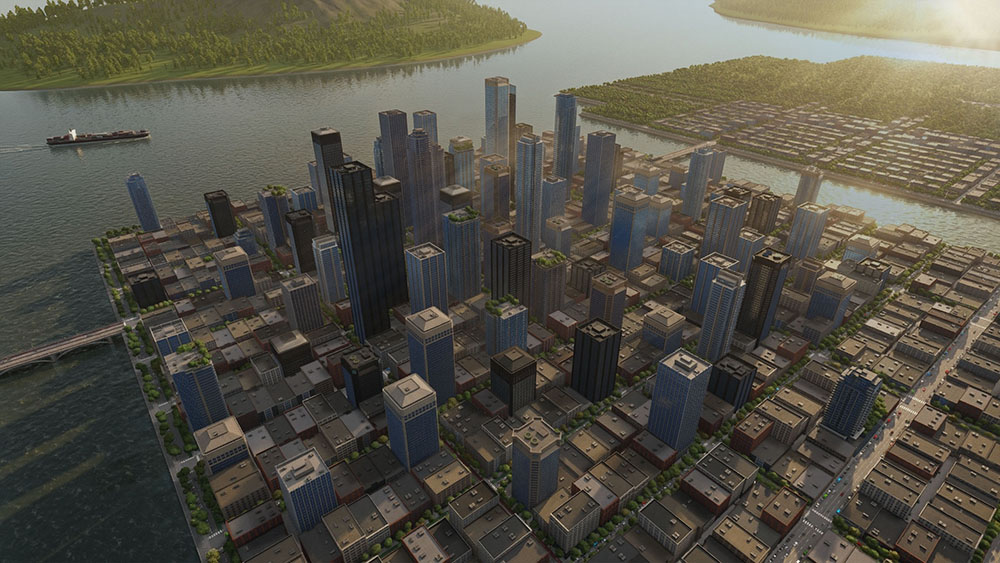
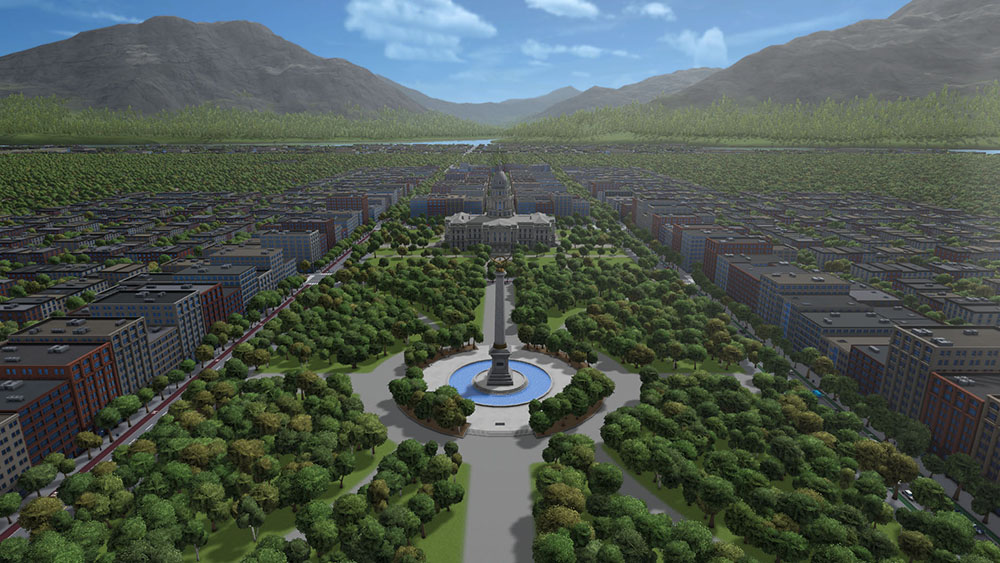
Metrotown is the first realistic city builder. Drawing on the knowledge of working professionals in city planning, civil engineering, transportation planning, and more, Metrotown aims to capture every significant detail as it exists in the real world, from the negative externalities of cars to the cost of planting street trees.
It's worth noting that realism doesn't inherently lead to well-designed cities. We can't just replicate what we see around us if we want to make cities that are livable. Take San Bernardino, CA for example — a very real city whose downtown is effectively one giant parking lot:
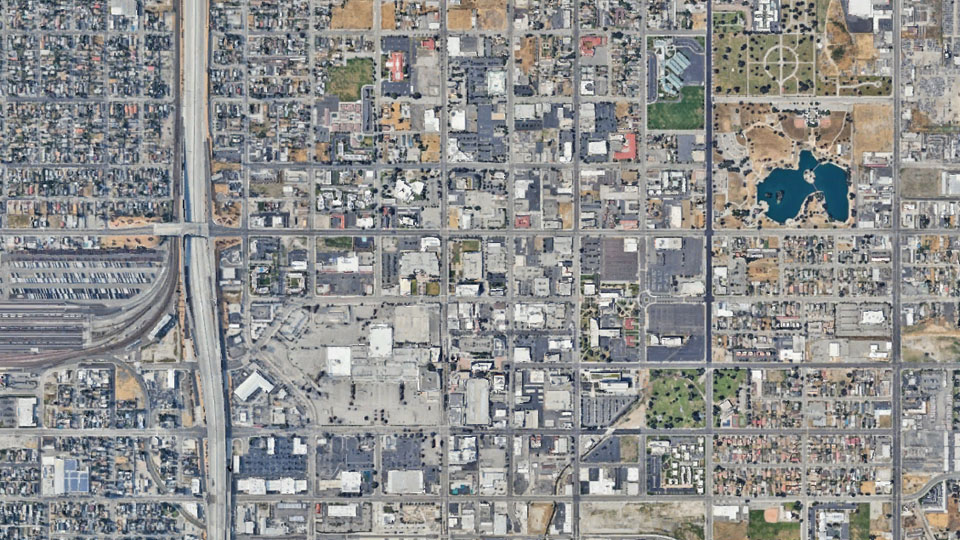
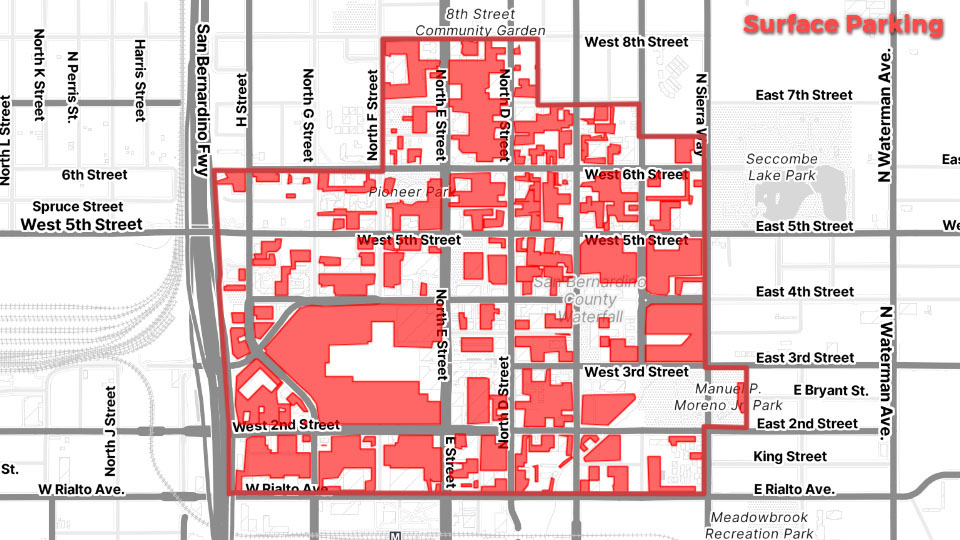

To avoid players' cities ending up like San Bernardino, it's important for the game to understand what makes a great city. It has to know that active frontage improves the pedestrian experience, or that running a freeway through your downtown is not a particularly good idea. To help achieve this, Metrotown follows an explicit design philosophy.
Design Goals
A city builder can focus on many different things, from the micro-management of turning lanes to the adoption of city-wide policies. What the game chooses to implement has a significant influence on how cities are presented to the player. These are the foundational principles that Metrotown is based on:
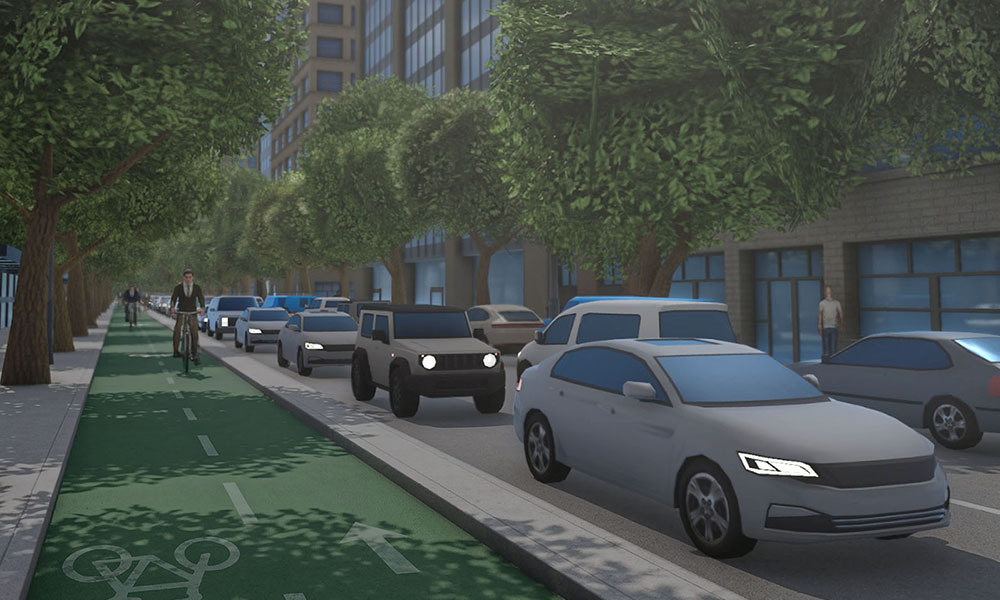
- New Urbanism: Cities are made for people — not cars. The negative externalities of cars can not be ignored, including noise, pollution, parking requirements, and reducing the safety of pedestrians and cyclists. Livable cities are based on walking, cycling, and public transit.
- Georgism: Land value is the most fundamental metric for city planning and growth. The city's primary revenue source is through a land value tax (LVT) — the most equitable form of taxation.
- Market-Driven: Decisions are only constrained by the real-world economics of implementing them. Private property must be purchased by the city before being repurposed. All revenues and expenditures closely resemble their real world values.
- Realisism: Optimizing for solvency and resident well-being results in cities that are realistic. All entities are 1:1 scale with their real-world counterparts.
What Metrotown is NOT
While it's important to know what the game is focused on, it's equally important to know what the game isn't trying to be. With so many options available, limiting the game's scope is key to a cohesive experience.
- A Traffic Simulator: Vehicles are not discrete entities with their own pathfinding and behavior. The player does not have the ability or need to optimize turning lanes, intersection timings, or other extremely localized road behaviors.
- A Political Simulator: There are no social or political issues for the player to manage, or policies to enact. This is not a political sandbox for evaluating how laws and regulations can impact residents.
- A City Painter: There are no options for fine-tuning the aesthetics of buildings or land, such as planting individual trees or adjusting the colors of buildings.
Summary
Metrotown is a city builder for the urbanist, the Georgist, and those looking for a greater challenge than what the genre currently provides. If this is you, then welcome. If this isn't you, then I don't know how you found this blog, but welcome anyways — it's too late to leave now.
What's Next?
Metrotown will be having an alpha playtest this fall that's open to anyone who's interested. You can join the Discord community, follow the game on X, or subscribe to the mailing list to be emailed when it starts.
In the meantime, I'll be adding new blog posts covering the core mechanics of the game, as well as new features as they're added. Thanks for reading!